Showing posts with label performance. Show all posts

Saturday, 6 February 2021

Interview with Crystal Fischetti

06/02/21
Interview with Crystal Fischetti 

Crystal Fischetti: Hello Again!
Grove Square Galleries, London
11 February – 9 April 2021
 
Besides being an artist, Crystal Fischetti (b1984, London, UK) is also an empath, psychic and shaman. For her forthcoming solo exhibition Hello Again!, she is bringing all aspects of herself together, creating “a beautiful marriage”. The 36 works on display – this number was chosen because it was her age when creating them, and Fischetti believes deeply in the power of numerology – are vibrant and pulsating, each one representing a visual journey, but also a return to self. The use of unprimed canvases goes back to the artists of the New York School, to whom she is often compared in style, and their elements of play, as well as of mysticism, and her use of bedsheets uncovers what it means to be at home, representing physical intimacy, rest and repose, lucid dreaming, and also a connection to the astral realm and the unconscious. 
 

Fischetti, who is of mixed British, Italian and Colombian heritage, trained as a dancer before turning to visual art, and she still uses her whole body to paint – often incorporating hand- and footprints in her works – and she hopes, in the future, to create more performative, live-painting pieces. 
 
I spoke to Fischetti for Studio International via Zoom about her calling by Spirit to be of service, how the pandemic has influenced her work, and the simple process of creating alchemy out of the things you have around you.


Watch the full interview here


Saturday, 5 September 2020

Interview with Alberta Whittle

05/09/20

Interview with Alberta Whittle

Alberta Whittle (b1980, Barbados) has had a phenomenal couple of years. The Glasgow-based artist, who works in film, sculpture, performance, collage and choreographed installation, was the recipient of the 2018-19 Margaret Tait Award and, this year, was one of the 10 artists to receive a Turner bursary award from Tate Britain, in place of the annual Turner Prize. She is about to show work in the Photoworks Festival in Brighton and in a group show at Copperfield in south-east London. 


The Liverpool Biennial and Art Night have been postponed due to the Covid-19 pandemic, giving Whittle a little longer to finesse her works for these events, but equally raising new challenges as to how to adapt to the restrictions and changes in the way she can interact with her audience – something which, for Whittle, is key, since she seeks to pose questions and unsettle people from their positions of privilege and passivity. Key themes in her work include anti-blackness, legacies of slavery and apartheid, the erasure of black people and people of colour in everyday society, and also environmental issues.


Whittle spoke to Studio International about her practice and motivations, the effect of the pandemic, and the role of viscerality in her work.


Read the full interview here


Sunday, 18 February 2018

Review of After White: Michaela Zimmer and Peter Welz at Fold Gallery, London

18/02/18
After White: Michaela Zimmer and Peter Welz 
Fold Gallery, London
2 February – 10 March 2018


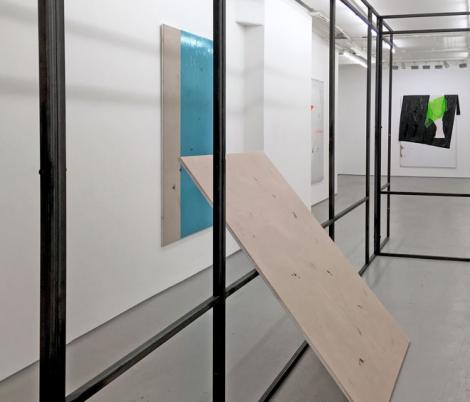
Fold Gallery in Fitzrovia, London, might be so-called for good reason – an awkward configuration to curate, it literally folds around the corner, creating an L-shape, in which it is impossible to step all that far back from most of its walls. It is the perfect space, however, for the current installation, which comprises paintings by Michaela Zimmer (b1964, Berlin) and an architectural-cum-sculptural intervention by her fellow Berlin-based colleague Peter Welz (b1972, Lauingen, Germany). Working together, they have turned the space into a bisected corridor, a climbing frame (although I am not sure that climbing would be encouraged), or discarded scaffold, which visitors are required to walk through, becoming a part of the work, interrupting and intervening themselves.


Read the full review here


Sunday, 16 April 2017

Essay: Laura Moreton-Griffiths

16/04/17
Essay: Laura Moreton-Griffiths

Like the myth of Pandora, Laura Moreton-Griffiths’ work might be seen as a kind of theodicy, addressing the question of why there is evil in the world. Brought up with a military background – her father was in the Royal Navy and her mother briefly a Wren – discipline and hierarchy were instilled in her from a young age, alongside a notion of patriarchy, which might well have been defined as: ‘blind obedience […]; the repression of all emotions except fear; the destruction of individual willpower; and the repression of thinking whenever it departs from the authority figure’s way of thinking’.[1] A lot of her work is based on arguments she used to have with her father, looking at human kindness and goodness and how ideologies get in the way. A key photographic series, for example, is Portrait as my Father (2016), in which, in the tradition of many female greats such as Claude Cahun, Cindy Sherman and Gillian Wearing, she plays the role of the person she seeks to understand.


This method seeps through her practice, be it photographic, drawn, installation-based, or performative. Often objects created for one medium will resurface in another. In Machine For Winning (2016), inspired by the 1936 Olympics, Moreton-Griffiths takes on the roles, amongst others, of dictator, spectator and mother. This series also sees her don what she terms ‘a wearable painting’, in this instance an ironically lugubrious smile, adopted from the 1930s’ Budapest Smile Club phenomenon, in which attendees wore the smiles of such characters as the Mona Lisa and Loretta Young, fixed Hannibal Lecter-like over their heads with medical tape, in an attempt to counteract the city’s post-war suicide epidemic.


Moreton-Griffiths’ work reflects the things she is opposed to and thus necessarily deals with issues of conflict, control and politics. She makes a piece with a specific meaning, but then lets it go for her viewers to find a meaning of their own, thus treading the line between personal and societal. Performance is key to her practice and, for this, there must be costumes – and these costumes constitute works in their own right. The Inglory Suit, a Ku Klux Klan hood and duffle coat, for example, or the less Machiavellian Gas Hood, become characters, whom Moreton-Griffiths takes on outings, seeking out and ‘meeting’ other randomly related objects to be photographed with.


The idea of playing the role of evil, in particular with relation to the Klan, is one that Philip Guston explored back in the 1960s: ‘The idea of evil fascinated me [...]. I almost tried to imagine that I was living with the Klan. What would it be like to be evil? To plan, to plot.’[2] While Guston grew up in Los Angeles, the child of Ukrainian Jewish parents, only too aware of Klan persecution of Jews, Blacks and others, Moreton-Griffiths has no such personal history, simply a keen sense of what is right and wrong in this world and a desire to unpick and understand the seemingly incomprehensible. Discovering her work’s commonalities with Guston’s, however, she took some photographs of herself in performance, wearing Gas Hood and the Klan hood, and turned them into Guston-like drawings. The characters in these – with their echoes of Nosferatu and creeping 1930s’ monsters (read: right-wing ideologies) lurking in the shadows – are now set to pop up elsewhere, so watch this space!


Moreton-Griffiths also works with text – in particular, she redacts certain documents. From the first page of the Human Rights Bill, for example, she has drawn out the words: ‘the incompatability of power to safeguard freedom’. From a page further in, all that remains is: ‘terror terror terror terror terror’ – a very clear echo of the patriarchal repression of all emotions except fear.

Moreton-Griffiths’ work is not all doom and gloom, however, and it bears a strong comic undercurrent. The plain white duffle coat, used as part of Inglory Suit, also appears elsewhere as her father’s arctic coat, and this reappropriation, or alteration of identity, suggests that nothing and no one is necessarily permanently fixed; redemption is always a possibility. Although the opening of Pandora’s box allowed evil into the world, hope remains inside.


[1] As defined by the psychotherapist John Bradshaw in his book, Creating Love. Cited in bell hooks, The Will to Change. Men, Masculinity, and Love, New York: Washington Square Press, 2004, p23.
[2] Guston quoted in Philip Guston Paintings 1969-1980, exhibition catalogue, Whitechapel Art Gallery, London, 1982, p54.


Images:


Sunk in the Arctic (2016)
From the series: Portrait as my Father
Collaborative digital photographic drawing on Arches Paper
112 cm x 140 cm
© Laura Moreton-Griffiths


A (2016)
Documentation of a performance.
Print on aluminium
30 x 20 cm
© Laura Moreton-Griffiths


The Group (2016)
Indian ink on Saunders Waterford paper
56 x 76 cm
© Laura Moreton-Griffiths


For more information on Laura Moreton-Griffiths, see her website


Friday, 17 March 2017

Interview with Serge Attukwei Clottey

17/03/17
Interview: Serge Attukwei Clottey

Born in Ghana in 1985, Serge Attukwei Clottey made his name internationally before he was finally recognised in his own country, thanks to a new commercial art gallery, Gallery 1957. His performances involve him and his collective, GoLokal, dressing in women’s clothes to collect plastic “gallons” (jerrycans used in Ghana to transport and store water), which he then cuts and uses as a mask, a canvas, or a basic building block for his installations. They have drawn positive responses, but also criticism from local people who do not understand the message – often political or social commentary – of his work. Despite a pending residency in Mexico, and being busy creating new work in between international art fairs, Attukwei Clottey found time to speak to Studio International via Skype from Accra.


Read this interview here


Thursday, 9 February 2017

Interview with Candida Powell-Williams

09/02/17
Interview: Candida Powell-Williams

Candida Powell-Williams: The Vernacular History of the Golden Rhubarb 
Bosse & Baum
28 January - 18 March 2017 

Candida Powell-Williams has long seen sculpture and performance as inseparable. Her current immersive installation at Bosse & Baum in Peckham, South London, brings together multiple elements, including both of these, as well as moving image, an artist’s book and even other artists’ editions, produced in an Exquisite Corpse-type manner throughout the duration of the exhibition.


Her second solo show with the gallery, The Vernacular History of the Golden Rhubarb grew out of a year-long residency at the British School in Rome, during which Powell-Williams collected implausible stories, documented in such a way as to make them believable. She became fascinated, primarily, by the objects and relics at the heart of these tales, and, in particular, by tourists’ behaviour in response to them. A performance workshop, held before the exhibition opened, offered participants the opportunity to interact with her sculptures, and footage of this has been drawn over and turned into gifs, which can be viewed by scanning QR codes in the gallery foyer. It was important for Powell-Williams to incorporate this public choreography as a work in its own right, rather than just through documentation. Similarly, she is producing an artist’s book, which, on one level, will act as an instruction manual for interacting with the exhibition, but, on another, will be an objet d’art itself.

Referencing well-known and lesser-known touristic objects from across Rome, represented here in a colourful manner, against a grey archaeological site backdrop, with de Chirico arches and cross-stitched frescoes from the Villa of Livia at Palazzo Massimo, the installation invites viewers in to explore and interpret to the best of their knowledge, adding a sprinkling of their own imagination to complete and enhance the already bizarre tales.

Powell-Williams showed Studio International around and explained some of her inspirations.

Watch the interview here


Tuesday, 10 May 2016

Interview with Martine Syms

10/05/16
Interview: Martine Syms

Martine Syms: Fact & Trouble 
Institute of Contemporary Arts
20 April - 19 June 2016


Drawing from a rich mixture of American pop culture, black aesthetics, philosophy and semiotics, Martine Syms (b1988) produces work across many media that strives for a specificity the artist knows not to exist. Instead, through her films, performances and other work, she hopes to raise questions about representation, the embodiment of imagery, the value of assimilation, and how popular culture becomes internalised. Incredibly widely read, Syms is also the founder of Dominica, a publishing imprint dedicated to exploring black aesthetics in visual culture. She spoke to Studio International about her latest exhibition, Fact & Trouble, at the ICA, London.


Read the interview here