Showing posts with label mental health. Show all posts

Friday, 12 June 2020

Interview with Studio Morison

12/06/20
Interview: Studio Morison 

Heather Peak Morison (b1973, UK) and Ivan Winston Morison (b1974, Turkey) have been working together for the past 15 years. Their collaborative practice incorporates aspects of art, sculpture, architecture and performance. They are co-directors of Studio Morison, an artist-led creative practice, and their blueprint for happiness. 

Studio Morison was selected last year as one of the artist practices to be commissioned by Wysing Arts Centre in Cambridgeshire as part of the three-year, region-wide arts commissioning programme New Geographies, funded by the national lottery through Arts Council England, which aims to bring contemporary art to unexpected places in the east of England. Their resulting work, MOTHER …, situated on Wicken Fen, is an interpretation of a traditional fenland hayrick, and offers a space for visitors to sit and shelter and be with nature. The work also engages with the connections between the natural world and our mental health. A series of four events, furthering this connection, has, in part, been postponed due to Covid-19.


I spoke to Heather and Ivan from Studio Morison, while under lockdown, about the ideas behind MOTHER … and the artists’ wider practice.  


Read the full interview here


Thursday, 9 April 2020

The impact of Covid-19 on artists. Part 3: building communities and finding inner resilience

09/04/20
Part 3: Building communities and finding inner resilience

In the third part of this five-part essay, comprising conversations with artists around the globe, we look at the impact the pandemic – and imposed isolation – is having on them in terms of community and inner resilience

In Italy, the first western country to be badly hit by Covid-19, Francesca Pasquali (b1980, Bologna) describes the situation vividly: “Helplessness, fear, confusion – these are just some of the sensations we’re experiencing at the moment. Some people are gone, others are waiting for a verdict, poised between life and death. Uncertainty walks beside me, beside us, hour after hour, day after day. However, I am convinced that in such a dark and sad period, we must find within us resources and motivation to make sure that everything starts again as soon as possible, with renewed enthusiasm and desire to do. DO! This is the imperative … My doing is in art, my welcoming refuge. I live in the countryside and my studio is a few steps from the house. I see it from the window as soon as I wake up. It just waits to get dirty, to be messed up! I am lucky to be able to continue working, pending receipt of new dates for the exhibitions that have been postponed. Postponed? Cancelled? Who can say with certainty? Today the phone no longer rings, no emails arrive except those that communicate that exhibitions, fairs and other events are postponed. The galleries are inactive; in Italy, culture was the first sector to be affected by closures. But we did not give up, we invented a new way of enjoying art, because the desire to know and see does not subside. Never before have social media and the internet been so vital a means of connection between the isolated self and the whole world. There is fear, it is tangible, but I don’t want to get overwhelmed by emotion. These are the moments in which a sense of community, of union, re-emerges, and the true values that keep a system up and running return. The same values that I try to convey with my work: involvement, activation, sharing, love for beauty. Culture is a common good, essential.”


Read the rest of part three here


Friday, 31 May 2019

Review of This Is What It Is To Be Happy at Paulilles Gallery, London

31/05/19
This Is What It Is To Be Happy
A group exhibition with Eleanor Johnson, William Kennedy & Gabriel Kenny-Ryder
Paulilles Gallery, Copeland Park, Unit 91, London
29 May – 2 June 2019

In an era where mental health issues are one of the main causes of health problems worldwide per se, with major depression thought to be the second leading cause of disability, and an estimated one in six people said to have experienced some form of mental health crisis during the past week (and this data is already a few years old), the underlying thread of this three-artist group show, This Is What It Is To Be Happy, could not be more relevant. Timing-wise, too, short as its run sadly is, it falls right at the tail end of Mental Health Awareness Month. 


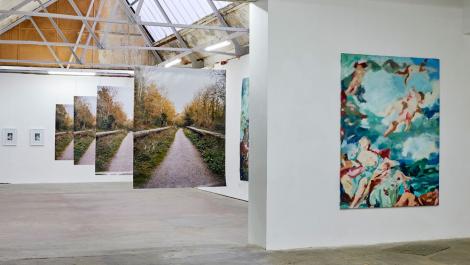
Ostensibly, however, this is an exhibition about biophilia, or our innate love for the natural world – or at least that is how it is described on the press release. Painter Eleanor Johnson (b1994), whose original concept it was, and in whose gallery it is being held, has created a new series of works, Modern Bathers, which collages together fragments of Rubens, François Boucher, and Old Master paintings, with images of her friends, in pastel, idyllic, bucolic settings, which she describes as “forest bathing”. Photographer Gabriel Kenny-Ryder (b1993), co-director of the gallery, presents panoramas, and one series of four freely hung images, of landscapes that absorb and envelop the viewer, while, simultaneously, providing stark reminders of their created materiality. It is William Kennedy (b1993), multidisciplinary artist and, here, film-maker, who freely verbalises the fact that he came along, as the third person in, and liberally interpreted this concept of inside and out, interiority and exteriority, inward and outward experience, to be a question of the mind and body, and thus, of our mental health. His frighteningly raw and visceral works, with their phantasmagorical finish, lay bare emotions many of us will have felt, but to which fewer of us will have admitted. 


Read the full review here


Tuesday, 20 February 2018

Review of Camille Claudel at Musée d’Orsay

20/02/18
Camille Claudel
Musée d’Orsay
9 January – 11 February 2018

With 2017 marking the centenary of the death of Auguste Rodin, many exhibitions are looking back and celebrating the French sculptor’s life. But what of his student, lover, assistant and contemporary, Camille Claudel (1864–1943), who, after the breakdown of their affair and the death of her father, was committed, by her younger brother Paul, to an asylum, where she lived out her remaining 30 years in misery, dying at the age of 78?


Despite critical acclaim and respect from her peers during her lifetime, her affair with Rodin and her struggles with mental illness have cast a shadow over contemporary interpretations of her work. Her brother, a poet, dramatist and diplomat, to whom she was once very close and of whom she sculpted numerous busts, organised an exhibition of her sculptures at the Musée Rodin eight years after her death, but even he, shortly thereafter, spoke of her life in derogatory terms, saying: “My sister Camille had an extraordinary beauty, moreover, an energy, an imagination, a quite exceptional passion. All these superb gifts came to nothing: after an extremely painful life, it ended in complete failure.”1 And yet there are works that, even today, have not decisively been attributed to either Claudel or Rodin, so symbiotic was their practice and so similar their style.2 Why, then, is she not up there on the pedestal with him?

Read the full review here


Tuesday, 18 July 2017

Review of Ida Applebroog: Mercy Hospital Hauser & Wirth, London

18/07/17
Ida Applebroog: Mercy Hospital
Hauser & Wirth, London
19 May – 29 July 2017

In 1969, Ida Horowitz (b1929), a struggling artist and mother of four, recently moved from Chicago to San Diego, was driving her two young sons to the zoo when suddenly she felt herself unravelling. She was unable to tell red from green, and her children had to guide her through set upon set of traffic lights. Later that day, recognising the danger, she checked herself into the mental health ward of Mercy Hospital.


Ida – who went on to become the internationally successful feminist artist Ida Applebroog (a made-up surname adopted when she felt the need to distance herself from both her maiden name, Appelbaum, and her married name, Horowitz) – had with her a sketchbook. During her six-week stay on the ward, she filled this with drawings and scribbled thoughts, and it is these excavations of her mind that now – after 40 years buried in a basement locker, until they were rediscovered by an studio assistant in 2009 – fill the walls of Hauser & Wirth London’s south gallery in a revealing and insightful show.


Read the review here


Friday, 22 January 2016

Portfolio: Liz Atkin

22/01/16
Portfolio: Liz Atkin

“I was pushing up from the bottom of the bath and the oily, inky water was swirling around me like liquor. It was such a perfect way for me to try to get that sickly, horrible feeling, that was in my body at the time, out into something visual.” In 2014, Liz Atkin suffered a 10-month bout of severe depression. An artist, who was already using her work to help combat her life-long battle with Compulsive Skin Picking (CSP), she was able, once more, to turn to creativity as a means of survival. “It enabled me to pull myself back to health,” she reflects. The resulting works, including Curdled (2014), were shown at ORTUS, for Bethlem Gallery, as part of the Anxiety Festival that year.

For Atkin, her chest and collarbone are particularly significant sites, since this is where she used to pick the most – up to eight hours a day sitting in front of a mirror, picking until she bled. Works like Blue (2014) revisit this violent battleground, touching it gently with chalk dusk on her fingertips. The fact that the colours conjure up a bruise is, of course, no coincidence.


Atkin has recently returned from a week-long trip to UCLA, where she was invited to exhibit her artwork and speak to medical students and staff about her lived experience of CSP, her artwork and her recovery.

“I don’t really talk in terms of being cured because it’s something I live with every day,” she says. “It’s something I’ve done for more than 25 years and my body knows skin picking better than anything. I have to work really hard for it not to happen and art helps. I’m always taking photos on my phone or drawing on the tube. It keeps me centred, focused and calm. It’s mindfulness in action.

“6-8% of the population are said to suffer from some form of body-focused repetitive behaviour, be that skin picking, hair pulling or a physical tick, but CSP is very misunderstood. I have a duty to tell the truth because every time I do so I am destigmatising it. It is not just a personal story, it becomes something that is human and universal.”


Liz Atkin is showing some work as part of LETTING IN THE LIGHT, a temporary lightbox installation organised by Daily Life Ltd in collaboration with Outside In and Bethlem Gallery at Gerry Raffles Square, E15, until the end of March.


Image:

Liz Atkin
Curdled
2014
© the artist


See the full portfolio in the February 2016 print issue of DIVA magazine


Thursday, 23 April 2015

A Snapshot of the Mind. Essay on mental health, photography and the work of Daniel Regan

23/04/15
A Snapshot of the Mind
Essay on mental health, photography and the work of Daniel Regan

Living with mental health issues is not easy. First, there is the struggle with the issues themselves, then there is the stigma attached. Society, in its general ignorance, has a fear of certain diagnoses – certain labels – and, as a result, many of us hide our struggles in shame. Feeling alone, feeling isolated, feeling like no one else could ever possibly feel – or do – as you do, let alone understand, is shaming – and shame is nothing if not self-perpetuating.


Recently, with the opening of the newly renovated Bethlem Gallery, I saw some work which shook me – shook me in a positive way – because, in it, I recognised my own behaviours, my own coping (or non-coping) mechanisms, my own shame. The relief of such cataclysmic moments, when, through looking at art, I am reminded that, actually, I am not alone, is always immense. Since this day, a few weeks back, I have been looking around for more artists whose work touches upon mental health and I was happily reminded of photographer Daniel Regan, whom I first met just over a year ago. Looking at Daniel’s work – as I have been in earnest this past week – has opened more doors to self-recognition, to feeling less alone, to a sense of hope, and to a pride – a pride in Daniel for being ‘one of us’ who is willing to speak out, to reach out, and, who, by empowering himself, empowers other people.


This essay was commissioned by Photoworks as part of their What Are You Looking At? ideas series.
To read the rest of this essay, please go to: http://photoworks.org.uk/snapshot-of-the-mind/

Image:
Daniel Regan
Shell
2012