Showing posts with label photography. Show all posts

Sunday, 27 December 2020

Toby Deveson: embracing the most sacred depths of souls

27/12/20

Toby Deveson: embracing the most sacred depths of souls 

Dance as the narration of a magical story; that recites on lips, illuminates imaginations and embraces the most sacred depths of souls. [Shah Asad Rizvi]


Before becoming a photographer, Toby Deveson wrote music. ‘Avant garde, atonal and arrhythmic’ is how he describes it. ‘Jarring and jolting.’ Even his use of alliterative adjectives – whether intentional or not – has a sense of the lyrical, and, born and largely brought up in Italy, he is certainly a passionate Romantic, in the true sense of the word (originating from a Romance country). Although his photographic journey began as one of documentary, his preferred genre these days is landscape: always black-and-white, always analogue, always full-frame negative. Deveson, in part, still approaches these images as if they were documentary, however: he seeks to capture not a story, per se – that, he says, would be too simple – rather the emotions of the place and the moment, that je ne sais quoi which will provoke a reaction and, he hopes, move the viewer to tears.


Deveson’s photographic compositions are infused with his talent for musical composition, and his approach, too, is similar. He speaks of finding the geometric pattern in the viewfinder, abstracted to the point where you almost don’t see what it is; you don’t see the textures or the shape, you just see the overall jigsaw. As Henri Cartier-Bresson said: ‘Thinking should be done before and after, not during photographing,’ and Deveson, likewise, describes building a foundation – a solid and stable structure with science, knowledge and experience – on which to then let his instinct loose to do something ‘nebulous and creative’, to dance as the narration of a magical story. 


Musician Brian Eno uses the metaphor of gardening for his compositional process: ‘The gardener takes his seeds and scatters them, knowing what he is planting but not quite what will grow where and when’. Deveson, similarly, admits to not necessarily knowing why he pours a certain chemical where and when he does, why the result is as it is, or why it looks good (or not!) – he simply learned what he needed to know through time and habit – he is largely self-taught – and follows his intuition.

But his compositional process is not a solo dance, it is a pas de deux with a quite extraordinary and demanding partner – Mother Nature. Nevertheless, Deveson takes the leading role – after all, as Ansel Adams made clear, ‘you don’t take a photograph, you make it’. ‘You’re having to let what’s in front of you into the camera, but also put yourself into the camera from behind,’ says Deveson, who sees the process as a two-way conversation – indeed, a dance, or the intimate – and often intricate – choreography of a relationship. ‘It’s exhilarating,’ he adds. ‘A relationship infused with wonder and awe, passion and fear. A relationship with an undercurrent of playfulness and power and a constant sense of potential danger.’ As in any union, it’s a case of holding one’s own shape, while respecting that of the other – meeting midway, caressing, moulding a little to each other’s form, becoming a ‘we’, but ultimately remaining two ‘I’s. Deveson speaks of the immense challenge of placing his style and emotions on to something as vast and imposing as Mother Nature: ‘To not be engulfed by her, and to not rely on her to provide you with a stunning image, but to work with her and create something unique from something so universal’. 

To this end, Deveson travels widely, frequently driving for hours at a time, a vague plan half hatched, his route being steered, nevertheless, by his wayward dance partner. He seeks to experience as much of her as he can, to celebrate her gifts, to rise to her challenges, to capture that elusive moment in their relationship when everything changes, when something is learned and can never again be unknown. As with most significant realisations, these often only come later, when he returns to his darkroom and exposes the fragments of a partially recollected dream, reliving them all the more vividly for their bright monochrome. The dream as a whole, however, can never be fully resuscitated, leaving Deveson – and, in turn, his viewer – with the narration of a magical story, weaving in the unique stance of the present, and that of the individual’s past. Cartier-Bresson coined his famous term ‘the decisive moment’ to describe the fact that ‘photography is the simultaneous recognition, in a fraction of a second, of the significance of an event as well as of a precise organisation of forms which give that event its proper expression’. Just as no two performances of a given dance will ever be identical, the event itself is necessarily ephemeral, but the image Deveson makes represents the essence thereof, recites on lips, illuminates imaginations and embraces the most sacred depths of souls. 


© Anna McNay, 2020

Image © Toby Deveson, 2020


See also Spanish and Italian translations on the Metralla Rosa site


Thursday, 23 July 2020

Interview with Toby Deveson

23/07/20
Interview with Toby Deveson

Toby Deveson (b1971, Milan) was given a Nikkormat camera by his father when he was 16. For more than 30 years, he has been using the same 24mm lens he “borrowed” from his dad. Largely self-taught in photography, Deveson composes his images much as he once composed music: building a solid foundation and a structure with science, before following his instincts. His enigmatic black-and-white images are never cropped. Having started out working in documentary photography, in particular in the orphanages in Romania, Deveson soon discovered his love of landscapes and the “exhilarating relationship” with Mother Nature. His dream is to provoke reaction and move someone to tears with a landscape rather than with a dying child.


Deveson spoke to Studio International about his journey – both to places in all four corners of the globe and in terms of his career development – and his desire to leave a legacy.

Read the full interview here


Monday, 20 January 2020

Interview with Paul Mpagi Sepuya at Modern Art, Vyner Street, London

20/01/20
Interview with Paul Mpagi Sepuya

Paul Mpagi Sepuya 
Modern Art, Vyner Street, London
11 January - 15 February 2020


Paul Mpagi Sepuya (b1982, California) began his photographic career taking straightforward portraits. Even today, a decade and a half later, he believes the basis of his work remains the traditional studio portrait, which he always takes of friends and people he knows; occasionally also of himself. His presence in the image, which is often overemphasised in curatorial selections, is very much secondary, however, with the key focus being on the camera itself, and the act of photography. By placing the camera or tripod at the centre of the composition, and using mirrors, frequently tainted with smudges and smears, so as to make evident their presence, he deconstructs the process, as well, frequently, as the resultant image, which is cut into fragments, later to reappear in other works. Although the images themselves are now taken digitally – purely as a means of expediency – Mpagi Sepuya does no digital manipulation of his works whatsoever. Everything that appears in the shot is actually there in his studio.


While Mpagi Sepuya’s work has often been described as being about queer identity, this is, again, secondary to the camera itself. Here he explains how, although black and queer experiences are clearly conditions that lead to the space that makes the work possible, it is these conditions themselves that interest him more than making any overt declarations about gender, sexuality or race. The compositions are not planned but arise out of his living with the material until it finds its way into an image. While there are myriad layers to his works, and, in fact, to the layperson, they might seem incredibly complex, Mpagi Sepuya maintains they are little more complicated than a selfie, shot by a teenager in a bathroom mirror. 

I spoke to Mpagi Sepuya for Studio International ahead of the opening of his first solo UK exhibition, taking place at Modern Art, Vyner Street, as part of CONDO. Watch the interview here.


Thursday, 3 October 2019

An Elusive Presence. WG Sebald: His Writing and Photography

03/10/19
Lines of Sight: WG Sebald’s East Anglia
Norwich Castle Museum & Art Gallery
10 May 2019 – 5 January 2020


Winfried Georg Sebald – known as WG to the literary world and as Max to his friends – was born in the Bavarian Alps on 18 May 1944. After studying German and English Literature, first at the University of Freiburg (Germany) and then the University of Fribourg (Switzerland), Sebald came to the UK in 1966, where he was a lector at the University of Manchester, before moving to – and settling in – East Anglia, with his Austrian-born wife Ute, in 1970. He first became a lecturer at the University of East Anglia (UEA), later being appointed to a chair of European Literature, and going on to become the founding director of the British Centre for Literary Translation. Author of four genre-defying novels, largely concerning the themes of memory and loss – Vertigo (1990), The Emigrants (1992), The Rings of Saturn (1995), and Austerlitz (2001) – as well as numerous essays, Sebald was tipped as a potential future winner of the Nobel Prize in Literature when he tragically died, in 2001, aged just 57, in a car accident, triggered by an aneurysm. 


Read my full essay here


Tuesday, 1 October 2019

Alexandro Pelaez and the Magical in the Realism

1/10/19
Alexandro Pelaez: Eclectic 
Bermondsey Project Space,London 
1 - 12 October 2019

“Magical Realism” is a term typically associated with Latin American literature, where the roots of the genre took hold after the Cuban revolution of 1959, applied to a new type of writing known for its matter-of-fact portrayal of magical events. The term, an adaptation of the German “Magic Realism” (minus the -al), which had been coined in the 1920s as an alternative name for the artistic movement of “New Objectivity”, has since been variously used, in the worlds of both art and literature, often simply to refer to the magic of the day to day, and the realities that we miss as we go about our mundane tasks. Professor Matthew Strecher, an expert on the subject, defines it as “what happens when a highly-detailed, realistic setting is invaded by something too strange to believe”. For Venezuelan-born, London-based, award-winning analogue photographer Alexandro Pelaez, the concept has become increasingly relevant in his work over the past few years, as he has progressively developed a style of fiction, able to capture a realistic view of the modern world, simultaneously adding magical and, at times, almost unnatural, elements. 

Pelaez achieves this primarily through his use of double exposure, meaning that you at once see both a “real” picture, but also a layer of the “unreal” or dreamlike. His pictures demand close observation, so that these details and layers may be unpicked – a task which is not always possible, since his scenarios are often so persuasive – and, either way, ought not some level of fantasy always be maintained, since to unpick it entirely would destroy the magic and leave behind mere reality? Pelaez began experimenting with the process of double – and even multiple – exposures in 2008, when he was creating his Heroes & Villains series using action figures. He has continued to develop the process in more recent work. Using his LC-A Lomography film camera, he takes the first image, with no specific duration between that and the next – it might be a minute, an hour, or even a whole day. These two frames meld as one as early as at the stage of the negative. What you see there is what you get. There is no need for any superimposition or postproduction. The only postproduction work Pelaez carries out is, in fact, scanning in his chosen negatives so as to apply a little extra contrast to the colours, heightening their surreality.


This current exhibition, curated by Mara Alves, is entitled ‘Eclectic’. It draws from the Londoners series, which Pelaez has been working on since 2016, shooting almost every week, as well as from images of Chichester, Hong Kong, Miami, Rome, San Francisco, Seoul, Shanghai, Tulum, Venice, and Vietri sul Mare. The selection process, therefore, of 28 images, was no simple feat – leading, in part, to the title. Another element is the breaking down of the works into four groups – cityscapes, street environments, moving-image works of the former, and landscape details – using different sizes for the printing of each set. For Pelaez, the resonance of “eclectic” meaning “to derive from a broad range of sources” is also significant, for, although using the same method, he always seeks to capture the uniqueness of the personality of every city or subject he photographs. “Eclecticism,” adds Alves, “draws upon multiple theories, styles or ideas to absorb complementary insights into a subject – just like Alexandro’s works – often without conventions or rules dictated, but with the same combinations of multiple different approaches”. The variations in scale of the works on display invite viewers to become absorbed by the larger pieces – almost as if they were traversing the streets, or walking the parks pictured, noticing the many details and being surprised by the unexpected – while the small-scale images offer a certain tantalising intimacy, bringing the viewer in close, reminding them that this is but a photograph, something magical, not quite something real.
For each of the places Pelaez visited, there was a specific reason, be it work, holidays, or visits to family or friends. Some places he knew well, and thus he might have a vision in mind for his shoots; others were new discoveries, where he had first to take time to get to know the environment, responding more instinctively with his lens. Rome, for example, is a city he has been visiting yearly since the age of two. His image of Piazza Navona is one of his favourites, showing the typical, old Roman buildings, their colours, the extravagant fountain, and the many street artists selling their work. To get the image he had in mind, Pelaez had to shoot a roll and a half of film in 40 degrees Celsius heat. “I was going back and forth, shooting again and again, and changing the settings of the camera every time. I’m sure the tourists, the waiters – everyone – thought I was crazy!”

Another of his favourites is London in the Rain II. “London has been my home for the last 18 years,” Pelaez explains, “and when I shot this picture (as for most of the series), it was a typical cold and rainy London day. I was sitting at the front of a double-decker bus, just entering Piccadilly Circus – when I finally saw the picture developed it felt like it was a version of Gotham City! But I believe it represents itself so well that it could almost be a self-portrait of London.”
San Francisco, on the other hand, was a city new to Pelaez, and so, in this instance, he walked and walked, shooting continuously, collating potential material. “I’m a bit of a perfectionist,” he says, “so when I am in a different country, I don’t want to take any chances and not capture the image that I worked so hard on.” By the second day, however, he feels, with hindsight, that he had an idea of what he wanted; of what he saw to be the true essence of the city. Nevertheless, no matter where he is, he continues to shoot, and, from a roll of 36 images, he selects on average maybe just one or two to keep. 
It is this search to capture the “true essence” that is Pelaez’s driving force. “I want all and nothing!” says the artist, himself inspired by the likes of Ansel Adams, Peter Lindbergh, Emmanuel Lubezki and Steve McCurry. “To capture that true essence of the moment or location is what inspires me. I love energy, so if I am walking on a busy street, I need to capture that vibrant scenario. I love it when there is a crowd, traffic, movement, and rhythm as well. I believe it gives the image life and lots of energy. If I’m shooting on a beach, however, I want to capture the calm and peace of it, the magic light of the sunset, or the strong colours of the blue sky or water and their surroundings.” Again, eclecticism at play – Pelaez always tries to capture the “vibe” of the moment; what that particular and unique frame has to offer. The question one might ask, then, is whether what they offer him is the same as what they offer the viewer? For Pelaez, it doesn’t matter. He loves observing how someone approaches an image for the first time, trying to understand what is happening, being captured by a detail, and then stepping back to process the picture in full, building their private narrative. And this is perhaps the most “magical” aspect in the overarching realism – the calling into play of each individual’s power of observation and each individual’s imagination; the taking them out of reality, for however brief a moment, to an otherworldly, dreamlike – and perhaps even eclectic – place. 


Images:
Liverpool St & Brick Lane © Alexandro Pelaez
London in the rain © Alexandro Pelaez


Friday, 6 September 2019

Gerty Simon: Missing Pieces in a Photographic Puzzle

06/09/19
Berlin/London: The Lost Photographs of Gerty Simon 
The Wiener Library 
30 May – 15 October 2019

One side effect of the forced migration of so many thousands of Jews from Nazi Germany in the 1930s was the significant number of highly-trained and professionally-active women, including photographers, who arrived in the UK, bringing with them new techniques and approaches. Among them, and, at the time one of the best known, was Gertrude (Gerty) Simon (1888-1970). Born into a well-to-do Jewish family in Bremen, she had moved to Berlin in the aftermath of the First World War. Both her husband (Wilhelm) and her father were lawyers. Paving her own career path, however, and teaching herself how to handle a camera, Simon started out with editorial photography in 1922, getting a work published just one year after the birth of her son, Bernard (Bernd). She soon became a successful portrait photographer, attracting, by the end of the decade, such renowned sitters as the singer (and Simon’s friend) Lotte Lenya, the artists Max Lieberman and Käthe Kollwitz, the scientist Albert Einstein, and the French politician Andre Tardieu (who later became the French Prime Minister). The recently deceased, then six-year-old, Judith Kerr, who went on to write the Mogseries and The Tiger Who Came to Tea, is also among those portrayed. Alongside these well-known personalities, Simon also captured the ‘new woman’ of Weimar Berlin, with her short hair, cigarettes, and frequently androgynous appearance. 


Read the full essay here


Friday, 31 May 2019

Review of This Is What It Is To Be Happy at Paulilles Gallery, London

31/05/19
This Is What It Is To Be Happy
A group exhibition with Eleanor Johnson, William Kennedy & Gabriel Kenny-Ryder
Paulilles Gallery, Copeland Park, Unit 91, London
29 May – 2 June 2019

In an era where mental health issues are one of the main causes of health problems worldwide per se, with major depression thought to be the second leading cause of disability, and an estimated one in six people said to have experienced some form of mental health crisis during the past week (and this data is already a few years old), the underlying thread of this three-artist group show, This Is What It Is To Be Happy, could not be more relevant. Timing-wise, too, short as its run sadly is, it falls right at the tail end of Mental Health Awareness Month. 


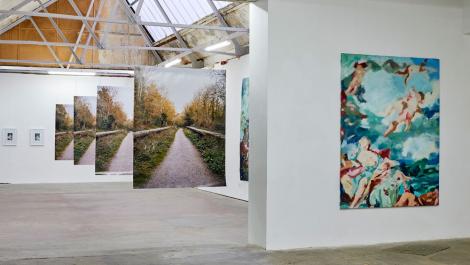
Ostensibly, however, this is an exhibition about biophilia, or our innate love for the natural world – or at least that is how it is described on the press release. Painter Eleanor Johnson (b1994), whose original concept it was, and in whose gallery it is being held, has created a new series of works, Modern Bathers, which collages together fragments of Rubens, François Boucher, and Old Master paintings, with images of her friends, in pastel, idyllic, bucolic settings, which she describes as “forest bathing”. Photographer Gabriel Kenny-Ryder (b1993), co-director of the gallery, presents panoramas, and one series of four freely hung images, of landscapes that absorb and envelop the viewer, while, simultaneously, providing stark reminders of their created materiality. It is William Kennedy (b1993), multidisciplinary artist and, here, film-maker, who freely verbalises the fact that he came along, as the third person in, and liberally interpreted this concept of inside and out, interiority and exteriority, inward and outward experience, to be a question of the mind and body, and thus, of our mental health. His frighteningly raw and visceral works, with their phantasmagorical finish, lay bare emotions many of us will have felt, but to which fewer of us will have admitted. 


Read the full review here


Saturday, 17 November 2018

Interview: Marilyn Stafford

Interview: Marilyn Stafford
October 2018

Born in Cleveland, Ohio, USA, in 1925, Marilyn Stafford never intended to become a photographer, yet her career is one of the most distinguished there could be. Having started out almost accidentally photographing Albert Einstein – for friends who were shooting a film and asked her to help them out – she moved to Paris, where her mentors included Henri Cartier-Bresson and Robert Capa, and where, alongside commissioned fashion photography, she also developed her documentary skills, photographing children living in one of the city’s worst slums (later bulldozed to make way for Paris Opera Bastille). Her onward path took her from Lebanon to India – where she spent several weeks with Indira Gandhi – and later to the London of the Swinging Sixties, where, juggling the challenges of single motherhood, she worked as one of very few women photographers on Fleet Street. Since retiring from photography in 1980, Stafford has lived in the sleepy town of Shoreham-by-Sea on the south coast of England. She is far from absent from the photographic scene, however, and, in 2017, set up the Marilyn Stafford FotoReportage Award, facilitated by FotoDocument and now also supported by Olympus, to help professional female photographers around the world with documentary photo projects addressing social, environmental, economic and cultural issues.


Read the full interview here


Friday, 16 February 2018

Q&A with Emli Bendixen

16/02/18
Q&A with Emli Bendixen
on the occasion of 3x3: An exhibition of nine women photographers
New Art Projects, London
11 January - 4 March 2018


Anna McNay: What are the key concerns or themes running through your practice?

Emli Bendixen: As a photographer, my interest is in finding beauty in the everyday. I photograph other people’s craft and lives with respect and warmth.

AMc: How much a part of your work does self-portraiture form?

EB: None. In fact, the thought of a self-portrait goes against what I’m interested in, which is other people – a curiosity of other lives lived. This exhibition has given me a chance to investigate myself as a subject/object of my own eye and lens.

AMc: As a woman looking at a woman (herself – but perhaps also other women, if you also make portraits of others), how aware are you of the conventions and load of the male gaze? To what extent do you work with or subvert these?

EB: I’m fortunate to work with and amongst people of all genders and I see it as part of my job to find strength and attractiveness in all subjects. It’s my duty to convey their beauty in the way I find to be most true to both them and myself. This applies to subjects of all genders – when I’m photographing, I see it as part of my role to love whomever is in front of the lens. Truthfully, I fall a little bit in love with everyone I photograph – It makes my job a lot easier.

AMc: How – if at all – does your sexuality influence or shape your work, especially your self-portraits? 

EB: I don’t make self-portraits – I’m even shy to make selfies on my phone. It’s something I should work on perhaps, seeing myself in the way I see others. That is, with wonder and admiration and a willingness to find that which makes them special.

AMc: As a woman who likes women, looking at women, do you feel your gaze is different from the gaze of a heterosexual woman artist? In what way?

EB: I do not. When I started my practice I still considered myself to be heterosexual and my gaze then as now was one of respect and wanting to know more. I applied this to all genders. As a woman who doesn’t look overtly lesbian, I honestly enjoy interacting with all people that I photograph. This is part of my job rather than my personality. Since becoming a mother, my gaze has adapted, expanded, finding attractiveness, affinity with other parents and our shared situation. A new focus on shared understanding of love of our children rather than self-love or sexualised love. Having a child has changed my gaze of the world in general. It has extended the way I view my partner from sexual to one of deep admiration and beyond for motherhood, parenthood.

AMc: Can you say something about the work you are submitting for this exhibition? How are you seeking to portray yourself? What are the key aspects you’re drawing forth? Physical, psychological, sociological…?

EB: Here, I portray myself privately, intimately but also slightly hidden (behind my mother role). My gaze meets the viewer’s without fear but with a sense of guardedness and protectiveness over my child. Although my partner isn’t visible in the photograph, she is there, behind the lens and the portrait becomes a family portrait, a queer family portrait of a mixed-race family. The image however can be viewed without any of this being known. That is how I can meet the gaze of the viewer. They think they know what they’re seeing but only part of the portrait is visible, same as neither mine nor baby Robin’s faces are fully visible. I suppose then I’m simply trying to portray that there is more than meets the eye. I may pass for heterosexual, the scene in the image may pass for heteronormative even – mother and child – but outside the frame is the context which includes our queerness.

AMc: Do you seek to portray yourself as object, subject, or both? How does this dynamic come through in your work?

EB: In this photograph – as an object, a vehicle perhaps to convey love for our baby, Robin. The portrait was directed and edited by me but taken by my partner, Julie Bendixen.

AMc: Do you work in media other than photography? If so, how does the gaze offered by the camera differ from the viewpoint obtained through other media? How does the experience as artist differ? Does it make the act of looking easier or more difficult? If you don’t work with other media, what is it about the gaze of the camera that attracts you to working with photography?

EB: I illustrate and write – both these outlets are much darker and less focused on a subject, they’re abstract and often fantastical. My photography on the other hand aims to be true, flattering perhaps but true. Loving but honest. I can’t say if it makes it easier or harder – I see no conflict as the subjects I explore are so different. If anything I would say my drawings and writing dig deep while my photograph holds to the light.

AMc: What one work of art, depicting a woman as object – or subject, have you been most influenced/impressed by and what is it about this work that captures you?

EB: I think the first photograph that really moved me was Nan Goldin’s Nan one month after being battered (1984). The sheer brutality and the way Goldin holds the viewer’s gaze was stunning and defiant but also accepting. 


Image:

Emli Bendixen
With R
2017


Also published here