Showing posts with label film. Show all posts

Saturday, 5 September 2020

Interview with Alberta Whittle

05/09/20

Interview with Alberta Whittle

Alberta Whittle (b1980, Barbados) has had a phenomenal couple of years. The Glasgow-based artist, who works in film, sculpture, performance, collage and choreographed installation, was the recipient of the 2018-19 Margaret Tait Award and, this year, was one of the 10 artists to receive a Turner bursary award from Tate Britain, in place of the annual Turner Prize. She is about to show work in the Photoworks Festival in Brighton and in a group show at Copperfield in south-east London. 


The Liverpool Biennial and Art Night have been postponed due to the Covid-19 pandemic, giving Whittle a little longer to finesse her works for these events, but equally raising new challenges as to how to adapt to the restrictions and changes in the way she can interact with her audience – something which, for Whittle, is key, since she seeks to pose questions and unsettle people from their positions of privilege and passivity. Key themes in her work include anti-blackness, legacies of slavery and apartheid, the erasure of black people and people of colour in everyday society, and also environmental issues.


Whittle spoke to Studio International about her practice and motivations, the effect of the pandemic, and the role of viscerality in her work.


Read the full interview here


Saturday, 16 November 2019

Interview with Larissa Sansour

16/11/19
Interview with Larissa Sansour

Larissa Sansour (born in East Jerusalem, 1973) is a Palestinian artist who now lives and works in London. She has studied at the Byam Shaw School of Art, London, the Maryland Institute College of Art, New York University, the University of Baltimore and the Royal Danish Academy of Fine Arts. Her work, frequently filmic, employs the genre of science fiction as a means of providing an alternative perspective on current social and political issues. In 2018, Sansour was appointed by the Danish Arts Foundation to represent Denmark at the Venice Biennale 2019, the 58th International Art Exhibition. For this, she created a new film, In Vitro, shown as part of a larger installation with the overall title Heirloom. 


I spoke to Sansour by Skype about the political motivations behind the work, its complex concept and layers of meaning, and how she feels about identity and memory – especially as a Palestinian.

Read the full interview here


Tuesday, 8 October 2019

Laura Jean Healey: The (Un)Holy Trinity

08/10/19
Laura Jean Healey: The (Un)Holy Trinity

Laura Jean Healey is an award-winning film-maker who uses the medium of film to explore the nature of the cinematic experience. Her particular focus is on the role and objectification of the female form on the screen. Her holographic film installation, The Siren (2012), shot underwater in slow-motion, won the Passion For Freedom Gold Film Award in 2014. She is currently working on a new project, The (Un)Holy Trinity, exploring the representation of three legendary ‘unnatural’ women: Lilith, Eve and Salome.


Can you summarise the concept behind your forthcoming work – a triptych of digital films, portraying Lilith, Eve and Salome, entitled The (Un)Holy Trinity? What do these three women represent, both in existing legend, and for you? 

Throughout history, these three women – taken directly from the Bible (Eve and Salome), or inspired by the inconstancies found within the book (Lilith) – have been vilified for their ‘unwomanly’ actions and used to serve as a warning as to how destructive female sexuality can be if left unchecked. 

According to Jewish law, Lilith was the first wife of Adam. She was made in the same manner as him and considered herself his equal. When he wanted her to lie beneath him, she refused to submit, enraging both Adam and God. In her frustration, she fled from paradise, and, in so doing, became a succubus (temptress of innocent men), breeder of evil spirits, and child-murdering monster of the night.
  
Eve, unlike Lilith, was not made as an equal to Adam. Even though both she and Adam ate from the Tree of the Knowledge of Good and Evil, bringing about the Fall of Man, it was Eve alone who bore the ultimate responsibility and was punished with the pain of childbirth and being subjected to her husband’s will.

Salome was a young virgin, who danced for her uncle/step-father, in order to win the head of John the Baptist. In her desperation to possess him, she exerted a more dominant, ‘masculine’ sexuality and was punished for this ‘monstrous’ nature

I have always been fascinated by these women’s stories. It is these cautionary tales of the ‘unnatural woman’ that have been used to justify holding back women throughout history. Even today, women are often still inherently judged by these unfair and contradictory standards.


Read the full profile interview here


Friday, 31 May 2019

Review of This Is What It Is To Be Happy at Paulilles Gallery, London

31/05/19
This Is What It Is To Be Happy
A group exhibition with Eleanor Johnson, William Kennedy & Gabriel Kenny-Ryder
Paulilles Gallery, Copeland Park, Unit 91, London
29 May – 2 June 2019

In an era where mental health issues are one of the main causes of health problems worldwide per se, with major depression thought to be the second leading cause of disability, and an estimated one in six people said to have experienced some form of mental health crisis during the past week (and this data is already a few years old), the underlying thread of this three-artist group show, This Is What It Is To Be Happy, could not be more relevant. Timing-wise, too, short as its run sadly is, it falls right at the tail end of Mental Health Awareness Month. 


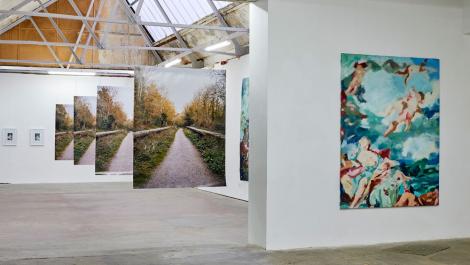
Ostensibly, however, this is an exhibition about biophilia, or our innate love for the natural world – or at least that is how it is described on the press release. Painter Eleanor Johnson (b1994), whose original concept it was, and in whose gallery it is being held, has created a new series of works, Modern Bathers, which collages together fragments of Rubens, François Boucher, and Old Master paintings, with images of her friends, in pastel, idyllic, bucolic settings, which she describes as “forest bathing”. Photographer Gabriel Kenny-Ryder (b1993), co-director of the gallery, presents panoramas, and one series of four freely hung images, of landscapes that absorb and envelop the viewer, while, simultaneously, providing stark reminders of their created materiality. It is William Kennedy (b1993), multidisciplinary artist and, here, film-maker, who freely verbalises the fact that he came along, as the third person in, and liberally interpreted this concept of inside and out, interiority and exteriority, inward and outward experience, to be a question of the mind and body, and thus, of our mental health. His frighteningly raw and visceral works, with their phantasmagorical finish, lay bare emotions many of us will have felt, but to which fewer of us will have admitted. 


Read the full review here


Sunday, 2 December 2018

Review of Renoir Father and Son: Painting and Cinema at Musée d’Orsay, Paris

02/12/18
Renoir Father and Son: Painting and CinemaMusée d’Orsay, Paris
6 November 2018 – 27 January 2019

Walking into the side galleries in the impressive Musée d’Orsay, Paris, on a wet and windy late-autumn day, there is suddenly the feeling of spring – a girl laughs as she gaily swings back and forth, and a young couple promenade, doe-eyed, enjoying the first throes of young love. In black and white, these scenes play out on a loop on a large screen – extracts from some of the best-known and best-loved early films by the French film director Jean Renoir (1894-1979), while, on the surrounding walls, colour luminesces, as the same – or very similar – scenes are frozen, like screen grabs, on the canvases of his father, Pierre-Auguste Renoir (1841-1919), the impressionist painter. 


And so it goes on for the duration of the exhibition, which fills the galleries along the length of the first floor of the museum: Renoir-father and Renoir-son interspersed and in conversation – repeated motifs, repeated scenery, repeated models. The idea is not to place Jean in his father’s shadow, but to explore the extent to which his father’s legacy, and their close relationship, with Jean’s intimate understanding of his father’s painting process, influenced his directing career – either in terms of deliberately paying homage to, or deliberately seeking to move away from, such ascendancy. As Jean said towards the end of his career: “I have spent my life trying to determine the extent of the influence of my father upon me,” going on to describe his ambivalence and the periods “when I did my utmost to escape from it to dwell upon those when my mind was filled with the precepts I thought I had gleaned from him”.

Read the full review here


Monday, 6 March 2017

Interview with Mahmoud Bakhshi

06/03/17
Interview: Mahmoud Bakhshi

Mahmoud Bakhshi: The Unity of Time and Place
narrative projects
26 January - 11 March 2017

The date 19 August is a significant one in Iranian history. In 1953, it saw the coup d’état, which gave the shah increased power to rule more firmly as a monarch, and, in 1978, it was the date of the tragic Cinema Rex fire, in which estimates of between 400 and 800 citizens lost their lives, when the building in Abadan, southern Iran, was set on fire by Islamic militants during the screening of the controversial film, The Deers (Gavaznha in Persian), directed by Masoud Kimiai. As two camps of opinion laid blame for the fire either with Islamic fundamentalists, who opposed all forms of entertainment (and were later found responsible), or the shah’s secret police, who some thought started the fire with the aim of pointing the finger at the fundamentalists, this latter event is widely considered to have triggered the 1979 revolution.


For The Unity of Time and Place, his second exhibition at narrative projects, Mahmoud Bakhshi (b1977, Tehran) has created an immersive installation, recreating the interior of a 1970s cinema, and showing incisively collaged film footage from The Deers and an interview with Kimiai, on two screens, either side of the central dividing wall.

The project reflects a wider focus of artistic enquiry in Bakhshi’s practice into the role and responsibility of an artist and his work, particularly when dealing with, or responding to, sociopolitical currents.

Bakhshi studied for a BA in sculpture at the faculty of fine arts at the University of Tehran, and has since held residencies at the Delfina Foundation in London and the Rijksakademie van beeldende kunsten in Amsterdam. His work was included in the National Pavilion of Iran at the 56th Venice Biennale and is held in collections worldwide, including Tate Modern, London; Doron Sebbag Art Collection, Tel Aviv; Devi Art Foundation, New Delhi; and the Thaddaeus Ropac Collection.


After his visa was denied at the last minute, and Bakhshi was unable to come to London to install his exhibition and attend the opening night, Studio International spoke to him in Tehran via Skype.

Read this interview here


Thursday, 3 November 2016

Interview with John Akomfrah

03/11/16
Interview: John Akomfrah
Artes Mundi 7
National Museum Cardiff
21/10/16 - 26/02/17

For the past three decades, Ghanaian-born British director, writer and theorist John Akomfrah has been highlighting the legacy of African diaspora in Europe by creating films that explore marginalised histories of European society. Having looked a lot at causality, he now feels drawn to shift his gaze to simultaneity, and his new split-screen film work, Auto da Fé, on show as part of the Artes Mundi 7 exhibition in Cardiff, looks at displacement as a result of religious persecution and what it’s like to live life with the precarity of not being able to take even simple things for granted.

In 2009, during a visit to Barbados, Akomfrah stumbled on a Sephardic Jewish cemetery. Not having known that such a community existed, he wanted to find out more. Auto da Fé refers to the Latin American variant of the Inquisition, resulting when Jews were kicked out, en masse, from Queen Isabella I’s Spain and Portugal in the 15th century. Akomfrah’s film, however, highlights the similarities between what happened then and what continues to happen across the globe today.


In the past, Akomfrah has described his films as “tone poems”. He explains what he meant by this and also reflects on the influence of Andrei Tarkovsky.

Akomfrah was a founding member of the Black Audio Film Collective, which was active between 1982 and1998. In 2008, he was awarded an OBE for his services to the British film industry.

Akomfrah spoke to Studio International at the opening of Artes Mundi 7 in Cardiff.


Watch this interview here


Thursday, 13 October 2016

Interview with Joey Holder at Wysing Arts Centre

13/10/16
Interview: Joey Holder

Joey Holder: Ophiux
Wysing Arts Centre, Cambridge
25 September – 20 November 2016

Working with cutting edge science, artist Joey Holder (b1981) has created an immersive clinical environment, into which the visitor enters, wearing blue shoe covers, to be confronted with a larger-than-life MRI scanner, tanks containing dried out deep sea creatures, and X-ray light boxes, on which magnified bacteria and a curious skull are displayed. This is Ophiux, a speculative pharmaceutical company of the not-too-distant future, working with synthetic biology, to create new, genetically modified life.


During her 2015 residency at Wysing Arts Centre in Cambridge Holder was introduced to Dr Marco Galardini, a computational biologist at the European Bioinformatics Institute at the Wellcome Trust Genome Campus, Cambridge, and Dr Katrin Linse, senior biodiversity biologist at the British Antarctic Survey, Cambridge. She has collaborated with them on her research to produce both the installation and the accompanying film, recently premiered at Deptford X, and soon to go on a national tour.  

Having studied sciences and art at A-level, Holder chose to follow an artistic career, studying first at Kingston University and later at Goldsmiths, where she obtained her MFA in 2010. Science has remained an enduring interest, however, as have curious and alien life forms, and – no doubt influenced by her time spent as a dive master in Turkey – the underwater world. This complex and thought-provoking exhibition brings together these diverse strands and makes a case for future such discourses between artists and scientists.

Holder showed Studio International around the installation and explained some of the science fact and science fiction involved.


Watch this interview here


Monday, 1 August 2016

Interview with Lamia Joreige

01/08/16
Interview: Lamia Joreige

Lamia Joreige (b1972) is a visual artist and film-maker who grew up in Lebanon during the civil war (1975-1990). She makes work about her own and others’ experiences, creating a new collective history, aside from the one presented in the media. Using archival documents and oral histories, she interrogates the notion of truth and explores the aftermath of war in her city, Beirut.


In 2011, Joreige’s work Objects of War [No 1 to 4, 1999-2006], a series of video testimonials and personal possessions, was the first major piece of Lebanese art to be acquired by the Tate Collection.

Joreige is one of seven artists to have been selected to show in the Artes Mundi 7 exhibition (21 October 2016 – 26 February 2017), the UK’s leading international contemporary art prize, from which a winner will be selected in January 2017, to receive £40,000, the UK’s largest monetary prize awarded to an artist. In the run-up to the exhibition in Cardiff (jointly held at the National Museum Cardiff and Chapter art galley, Cardiff), Joreige explained some of the concepts behind her work in a Skype call from Beirut.

Read this interview here


Tuesday, 10 May 2016

Interview with Martine Syms

10/05/16
Interview: Martine Syms

Martine Syms: Fact & Trouble 
Institute of Contemporary Arts
20 April - 19 June 2016


Drawing from a rich mixture of American pop culture, black aesthetics, philosophy and semiotics, Martine Syms (b1988) produces work across many media that strives for a specificity the artist knows not to exist. Instead, through her films, performances and other work, she hopes to raise questions about representation, the embodiment of imagery, the value of assimilation, and how popular culture becomes internalised. Incredibly widely read, Syms is also the founder of Dominica, a publishing imprint dedicated to exploring black aesthetics in visual culture. She spoke to Studio International about her latest exhibition, Fact & Trouble, at the ICA, London.


Read the interview here