Friday, 14 October 2011

Review of Grayson Perry: The Tomb of the Unknown Craftsman at the British Museum

13/10/11
Grayson Perry: The Tomb of the Unknown Craftsman
The British Museum
6 October 2011 – 19 February 2012


“Do not look too hard for meaning here. I am not a historian, I am an artist. That is all you need to know.” This is the warning placed in the very first wall text by artist, curator, and guide, Grayson Perry, as one enters The Tomb of the Unknown Craftsman, the fruit of a two and a half year long project at the British Museum. Yet, as Director Neil Macgregor points out, such a grand scale assemblage of art and artefacts almost begs us to do just that. The exhibition contains some 200 objects selected by Perry from the museum’s collection, along with around 35 pieces of his own work, a mixture of both old and new, of which nine are his trademark ceramic pots. The title of the show is, in part, a reminder of the many unrecognised artists’ and craftsmen’s work included alongside Perry’s, but, as he says, it could also be another name for the British Museum itself.

Whilst it is increasingly common practice for contemporary artists to be invited in to make their “response” to a historical collection, this is not what Perry has done here. Instead, he chose to first produce his own work, and then to find objects in the collection which respond to this. Arrogant and self-aggrandising? Perry argues not, since, after all, everything in the British Museum was, itself, contemporary once. Thus we find pairings of similar objects which bridge both time and space, starting, for example, with a ceremonial headdress from Asante, Ghana, made of shell, gold, deerskin, silver, and hair, displayed next to the imaginative Early English Motorcycle Helmet, actually made in 1981 by Perry himself, and Bodyguard’s Helmet (2010), the white, pink and green crash helmet worn by Perry, in his role as driver and bodyguard, when he took his teddy bear, Alan Measles, on a trip across Germany in his “pope mobile” shrine, AM1.

“[The exhibition] is basically a short tour through my head. I’m here with all my flaws, all my eccentricities, all my perversions. I’m a bit mad! My job is to play in public, but this is not an easy thing to do. There’s an amphitheatre in my head populated by cynical journalists and avaricious collectors.” Nevertheless, Perry manages well to provide an exploration of his own invented civilisation, structured around various key themes which include shrines, souvenirs of pilgrimage, scary figures, magick, maps, sexuality and gender, craftsmanship, and, of course, star of the show, Alan Measles.

“When I was a toddler Alan was the name of my best human friend and I also had measles.” Such were the humble origins of the bear who went on to become a military hero, surrogate father figure, embodiment of Perry’s suppressed male rebelliousness, and, later, his personal god and guru. “The idea of Alan as a god, like so many of my ideas, began as a joke when I was in Japan. [But] soft toys, particularly those that become a child’s special favourite, their “transitional object”, have much in common with traditional gods.” Thus, alongside a section which contains representations of bears throughout history, ranging from a wooden figure of the Egyptian god Bes to a German medal from 1916, we also find Shrine to Alan Measles (2007), made of glazed ceramic, and inspired by the Buddhist and Shinto roadside shrines Perry saw everywhere in Japan. “Shrines to me embody the essence of what I do. I put significant artefacts in a special place for us to contemplate upon [sic].” Likewise, the concept of pilgrimage plays a key role in this collection, not least because, as Perry points out, “the British Museum is the central site of pilgrimage in Britain – the number one tourist attraction,” but also because “I come on a journey every time I visit the British Museum […] I can have an encounter with the entire world.”

For Perry, creativity is all about cultural exchange. But, in his eyes, it is like a game of Chinese whispers, where, as traditions and ideas get passed on, mistakes are made. Craftsmanship is often mistaken for precision, but this is not what it’s about. You do not necessarily need state of the art tools to produce a masterpiece. Perry’s personal favourite from his own work in the exhibition is a case in point: made on the kitchen table of his squat, back in 1983, La Tour de Claire (Claire being his female alter-ego) is a fairy-tale turret built of small pieces of flint, wood, and other found objects, all crowned with a weather vane in the shape of Alan Measles. My own personal favourite, however, of the items not created by Perry, is a doll found in grave in Peru (AD 900-1430), which really does look like an ancestor of Alan himself (and not that much more worn, either!).

Disappointed not to get a glimpse of the great guru, I ask Perry where Alan Measles is today, and whether or not he will be coming along to his exhibition at any point. The answer, it would seem, is no (hence the competition, run in the lead up to the opening, to find three replacement stunt bears to sit in Alan Measles’ shrine on AM1). “[He’s] at home in bed. He’s so precious to me that I don’t even trust the British Museum with him. He’s beyond security!” Ah well. The pilgrim to this great shrine will simply have to satisfy himself with the vast array of false icons in their myriad of forms. I don’t think any twinge of disappointment will last for long.


A catalogue to accompany the exhibition, Grayson Perry: The Tomb of the Unknown Craftsman (British Museum Press, 2011), is also available, containing further wise words by Perry.
See also Alan Measles’ blog: http://alanmeasles.posterous.com/

Tuesday, 11 October 2011

Review of Gabriel Kuri: Before Contingency After the Fact

05/10/11

Gabriel Kuri: Before Contingency After the Fact
South London Gallery
29 September – 27 November 2011


Many of the recent exhibitions at the South London Gallery have, in one way or another, explored its location, making use of its rear garden, backing on to a once quite notorious housing estate. Gabriel Kuri’s show, Before Contingency After the Fact, is no exception. Born in Mexico in 1970, this is his first solo exhibition in a London public gallery and consists entirely of new works which fill the main gallery space, the Clore Studio, and the garden in between.

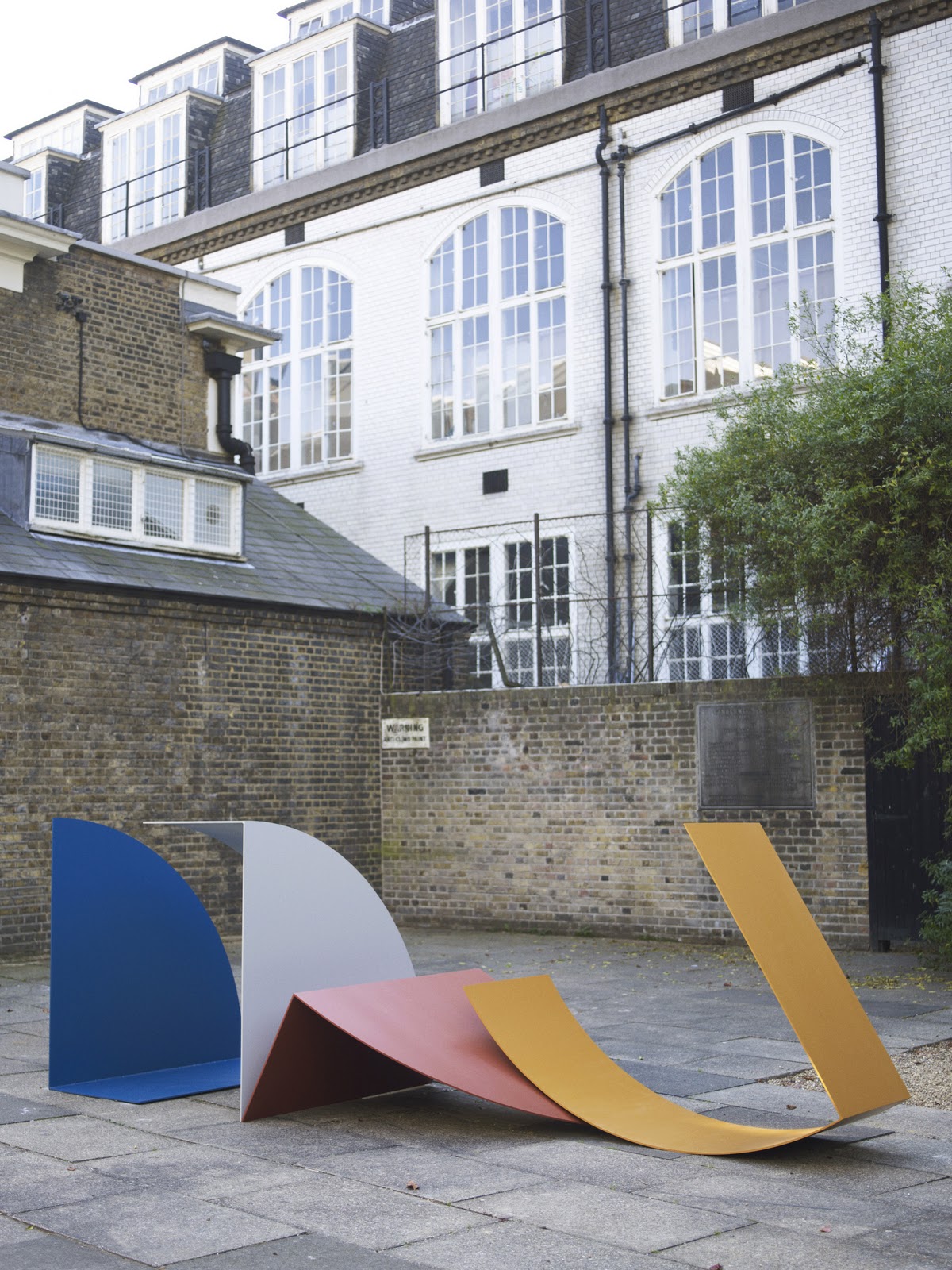
Kuri’s sculptural work is known for its investigation of the relationship between “hard” and “soft” materials, and for probing the formal possibilities and nature of sculpture itself. These themes are continued here, but expanded to work with more political and existential themes, looking at the basic human instinct to mark out territory, and, quite simply, at the basic needs people have in order to survive. His large metal sculptures, painted in primary colours, are formed like sloping shelters, big enough for a body to lie beneath. The provision of grubby blankets (Untitled (3/4 Blue) (2011) furthers this functional suggestion.  Next to this, Untitled (Extra Safe) (2011), half a constructed, cream-coloured, metal shelter, half a rusted skip, matched in their pie-chart sliced shapes, is propped up on an inflated condom, symbolic perhaps of the most carnal of all human needs: the drives, desires, and innate survival instinct of both the individual and the race at large.


Similar pie-chart shaped constructions inhabit the neighbouring Clore Studio, reached through the garden, itself passed into beneath Untitled (Opening) (2011), a huge pair of curtains, pinned open, and inviting the visitor to proceed. These burnt red, hollow, segments not only explore the opposition of positive and negative space, but also hint at the statistical representation of data, in a room largely furnished with prototype versions of polling tables and voting booths, themselves adorned with and supported by more essentials of life – bottles of water and used bars of soap (is hygiene and the ability to wash oneself a luxury, or a basic instinct? Surely the latter, if we think of cats and other species and their constant preening?). The political inferences are apparent: who is in charge? Who holds the power? Who makes the decisions? Who is directly affected? Whose voice is heard? What really matters? Is the man on the street really impacted, for better or worse, by the actions of those who, quite frankly, live, move, and preside in a different sphere altogether? One booth, Untitled (Charted Topography) (2011), is also littered with vibrant yellow, sealed glass ashtrays containing the fossilised remains of cigarette butts, the last dregs of existence.

The largest work in the exhibition, Untitled (Shelter) (2011), is an installation of gravestone-like marble slabs, metre-high matchsticks (some used, some not), chopped up oversized credit cards, grey undercarpet, flattened cardboard boxes, dishcloths, empty energy drink cans, partition screens, and a cluster of sweatshirts and hoodies, jackets and shirts, hanging like a raised pyre. This could, if we overlook the surreal Alice in Wonderland sized elements, constitute the meagre components of a homeless person’s living quarters. The outsized additions, then, are a stark reference to consumerism and the misguided values of the wealthier society which overlooks those in need, itself forgetting what it is like – if ever having even known – to struggle for survival and make do with only the bare necessities. Life or death – existence in a nutshell – with the marble slabs a towering memento mori.


Image credits:

Gabriel Kuri, Untitled (Opening), 2011, scaffold screen on wire, installation view South London Gallery. Photo: Marius W Hansen.

Gabriel Kuri, Untitled (Extra Safe), 2011, painted metal and inflated condom, installation view South London Gallery. Photo: Marius W Hansen.

Gabriel Kuri, Untitled (100%), 2011, painted metal, installation view South London Galler. Photo: Marius W Hansen.

All images courtesy the artist and the South London Gallery.


Monday, 3 October 2011

Review of Xavier White's Survivors: Guilt and Arrogance

20/09/11


Xavier White
Survivors: Guilt and Arrogance

Brain Injury Awareness Vitrine 

London Metropolitan University
Commercial Road
Whitechapel Library entrance display case

Open 9 - 15 May 2011 for National Brain Injury Awareness Week, then continuing until 20 September 2011


We often forget just how fragile and temporary human life actually is, and how quickly it can be taken from us, or altered, in the bat of an eyelid, never to be the same again. Xavier White’s display cabinet, a tribute to National Head Injury Week, and a personal memento mori – or is it rather a memento vitae? – is breathtakingly beautiful, and heart stoppingly honest, all at once. Three glass shelves filled with broken glass bottles and vases, some decorated with pearls, strewn over leaflets containing information about the effects of head injury on personality and emotions; anatomy models, of body and brain; artists’ models, contorted into impossible postures and nailed through the palms with pearls (religious suffering, passion, martyrdom. Punishment for sins. Whose? Our own? Is an accident ever an accident, or is everything controlled and served up accordingly by a greater master?); bicycle chains (a direct reference to White’s own accident); a foil wrapped milliner’s head, sporting rose-tinted shades (a reference to the oblivion in which so many of us exist?) and a barbed wire crown of thorns, itself also interwoven with pearls; a shattered mug, broken shards, upon which a crossword, with neurological word fragments (grasping at clues, rebuilding one’s knowledge, one’s vocabulary, one’s memories – a jigsaw of snapshots from a previous identity and life); a poem, Head Injury, by Roger McGough; and framing it all, around the outside of the case, the words: “Survivors: the guilt and arrogance… for sanity and sins discuss…” Guilt for what? For surviving when others didn’t? For the trouble inflicted on family and friends as they have to learn to live with this altered person, at once a shadow and an exaggeration of him whom they knew and loved before… Everywhere just fragments, shattered and broken pieces of a life – or lives – of relationships, of hopes, of dreams… Yet still beautiful, still valuable, still pearls – delicate and exposed, in need of protection, but something which will grow again, potentials… What is perfection anyhow? Something unadulterated and raw? Truth? Innocence? Or something which has grown and developed? The result of a process? Of aspiration? Only later revealed, and always then at risk? A badge, tilted downwards, with the word “naked”: like the pearls, stripped bare. A mere object for the medical profession. A green glass bell. Ringing? Inside one’s head. Inside or out? If it’s broken, surely it’s both – there can be no distinction. Constant sound. Thoughts which won’t subside. The longing for silence, for peace. Memories being obliterated, buried, confused… And at the very bottom, a blue tinted glass star. In tact. Is this hope? Something which remains unbroken? Which cannot be extinguished? Something which shines on. Light. Love. Life. Temporary and fleeting, yet, once the individual is removed, eternal.

Thursday, 29 September 2011

Review of EJ Major: Shoulder to Shoulder at Matt Roberts Arts

19/09/11

EJ Major: Shoulder to Shoulder
Matt Roberts Arts
2 – 24 September 2011

EJ Major, an artist and lecturer at Middlesex University, who graduated with an MFA in Fine Art from Goldsmiths in 2009, this year beat nearly 1000 international photographers to win the new Salon Photo Prize, organised by Matt Roberts Arts, and judged, amongst others, by Simon Baker (Curator of Photography at Tate) and Stefanie Braun (Curator at the Photographers’ Gallery). Alongside the financial reward of £1000, she also won the opportunity for a solo show, held at Matt Roberts Arts, in the trendy East London arts hub of Vyner Street, this month.

Major’s photographic works, which include both digital and analogue technologies, are rooted in questions of identity and performance: how we both construct ourselves and are simultaneously constructed by the people, things, and events around us. Her works bear reference to historical and contemporary events, intertwining the two, and constructing a new narrative. The result is layered, remaining both a document to the past, but also opening up a conceptual space where questions of personal motive and relevance become pertinent, should the viewer wish to venture down this route. Major usually incorporates text as well as image, and claims to be “interested in how these two forms of representation enforce and displace meaning.”

This solo show consists of two main bodies of work: the eponymous Shoulder to Shoulder (2009-2011), shown here for the first time, filling the walls of the main gallery space, and Marie Claire RIP (2004-2007), already widely toured, which hangs in the back room. This earlier work, which consists of 12 portraits, hung in two rows of six, is based on a set of police mug shots of an anonymous female heroin addict, taken over a 14 year period, which appeared in an article in Marie Claire magazine in 2002. The article revealed that the woman was found dead not long after the final picture was taken, and the images therefore formed part of an anti heroin campaign. Major saw the original photos in a magazine at a friend’s house, and, weeks later, still haunted by the images in her head, asked her friend for the magazine, scanned them in to her computer, and began working on them. This series constitutes a restaging, with Major herself taking on the triple role of model, photographer, and retoucher – an experience she describes with hindsight as “very intense and quite isolating”[1]. The piece grew out of a desire to memorialise the unnamed woman, to give her a name, and also, through the addition of small textual annotations (“did not cry”, “do not care”, “hid in fear”, “i did it”, etc.) at the foot of each image, to initiate a narrative, reminding the viewer that no person’s life can be condensed to a set of just 12 images. By playing the role herself, Major challenges the authenticity of the photographic portrait and the role of acting in the creation of any individual identity. She is also keen to point out that there is, in her work, no direct reference to heroin, since, for her, that’s not really what it’s about: the story is certainly one of the individual’s personal demise, but also that of every (wo-)man’s.

Shoulder to Shoulder likewise tells the story of both the individual and society at large. Really, it falls into two parts, linked intrinsically through their historical reference. Three large colour pieces comprise Seriously Damaged By Attack, based on the attack on Velázquez’s Rokeby Venus, on 10 March 1914, by militant suffragette Mary Richardson. Armed with an axe, fixed inside her jacket sleeve and held in place by a chain of safety pins, Canadian born Richardson entered London’s National Gallery unnoticed, and, after hours of hesitation, quite literally let rip, slashing the only surviving female nude by the leading artist of the Spanish Golden Age a total of seven times. Although the attack had been being planned for some time, it is said to have been triggered by the arrest, the previous day, of fellow suffragette Emmeline Pankhurst. Richardson, who was sentenced to the maximum term of six months’ imprisonment for the destruction of an artwork, later explained: “Values were stressed from a financial point of view and not the human. I felt I must make my protest from the financial point of view, therefore, as well as letting it be seen as a symbolic act. I had to draw the parallel between the public’s indifference to Mrs. Pankhurst’s slow destruction and the destruction of some financially valuable object.” She further added, in a statement to the Women’s Social and Political Union: “I have tried to destroy the picture of the most beautiful woman in mythological history as a protest against the Government for destroying Mrs. Pankhurst, who is the most beautiful character in modern history.”

In Major’s rendering of events, we see first Venus Vanitas – part re-enactment, part photographic composite – a modern reworking of the painting itself, with Major as both Venus and Cupid, and the reflection in the mirror posed by her mother – a stark comment on the demands of ideal beauty in contemporary society as youthful, botoxed, and wrinkle-free. The second photograph shows Major in the role of Richardson, standing before the genuine Velázquez, axe in hand. The final of the three images is of the aftermath: a slashed black and white news image of the damaged masterpiece standing below a framed portrait of Richardson, all set against satin drapes, in the colours of the Suffragette flag (purple, white and green), with a mysterious and disturbing figure in the foreground. Mummified in white satin, with only her hands protruding above her head, she is squeezing a cable release bulb. This is the most recent work Major has made, and she confesses to not yet fully knowing what it means: “The longer I live with the works once made, the clearer they become. The desire to make work, for me at least, comes of some enquiry fizzing away in my mind. It is only when I cannot answer or even articulate the question that I resort to making work. As the work gets made, the fizzing (usually) begins to abate or at least move elsewhere, and I begin to come to some understanding of what I’ve been fizzing about.”[2] My own response on seeing this image was to interpret the bulb as a detonator, resonant perhaps of modern day militancy (aka terrorism?) and those prepared to give their lives for a cause in which they truly believe. Major’s desire that viewers should seek their own readings and relevancies is therefore clearly effective.

The rest of Shoulder to Shoulder is made up of a series of black and white photos – four small landscape shots, taken from archives (some manipulated, some not), and three larger contact sheets – all relating to the theme of suffrage and protest, something in which Major has become increasingly interested over the past few years. As she explains on her website[3]: “The Suffragette movement provides a historical context for the performance and investigation of protest today, a fixed vantage point from which to explore the myriad issues at play in contemporary society.” The women in prison uniforms clearly evoke the fate of Richardson and her cohorts, and the placard calling for “deeds not words” echoes their radical approach, but through their deliberate coalescence of these early 20th century protests with those of more recent years, concerning such issues as climate change and welfare cuts, the photographs’ complex narratives place today’s protesters – Major’s audience, and Major herself, who appears in most of the shots, and attended the climate change march, as pictured, in a full length Suffragette prison uniform, borrowed from National Theatre Costume Hire company – in amongst their ancestors, both lending weight to the contemporary issues, but also revitalising old battles, and perhaps hinting that the struggle for gender equality is not yet won.

Major’s use of series of stills is a longstanding feature of her work and stems from when she was working with films, as, for example, in Try To Do Things We Can All Understand (2003-2008), freezing frames in an attempt to see whether she could apply Barthes’ notion of the punctum (that which is purely personal and dependent on each individual viewer, in contrast to the symbolic meaning of an image, or its studium) to the moving image. My impression, on viewing these works, however, is that she achieves a strong and powerful blurring of the two: as later generations of feminists went on to note, the personal is political. Our identity is formed of both our collective and individual past and present. We can escape from neither. The lives of others impact inescapably on our own.


[1] An interview with artist E J Major by Jessica Furseth for Amelia’s Magazine, 28/07/11 http://www.ameliasmagazine.com/art/ej-major/2011/07/28/
[2] Personal correspondence with the artist, 16/09/11


Originally published at: http://www.rovesandroams.com/2011/09/review-ej-majors-shoulder-to-shoulder-at-matt-roberts-arts/


See also: http://www.ejmajor.co.uk/ and http://www.mattroberts.org.uk/

Abstraction and Atonality, Museum Kampa, Prague

06/09/11

Abstraction and Atonality
Wassily Kandinsky, František Kupka, and Arnold Schönberg
Museum Kampa, Prague
12 May–31 July 2011 (extended to 31 August 2011)

by ANNA McNAY
František Kupka (1871–1957) is generally recognised to be the best-known Czech artist from the 20th century, and Museum Kampa in Prague is proud to house one of the largest private collections of his work. It is not surprising, therefore, that their recent exhibition – successful enough to be extended by a month – focused largely on his story, with Wassily Kandinsky (1866–1944) and Arnold Schönberg (1874–1951) as peripheral figures. This did not, however, detract from the show, for which the driving concept was an examination of the relationship between abstraction and atonality, or patterns of music and visual composition.


To read the rest of this review please go to:

Copyright © 1893–2011 The Studio Trust. The titles Studio International and The Studio are the property of The Studio Trust and, together with the content, are bound by copyright. All rights reserved

Rudolf Steiner and Contemporary Art and Thinking without limits: Inspired by Rudolf Steiner, DOX Centre for Contemporary Art, Prague

05/09/11

Rudolf Steiner and Contemporary Art
and
Thinking without limits: Inspired by Rudolf Steiner
DOX Centre for Contemporary Art, Prague
16 June–12 September 2011

by ANNA McNAY
“Think about a 20th century without Rudolf Steiner – it would be a catastrophe.” So says Tony Cragg (born 1949), one of the artists whose work is included in Rudolf Steiner and Contemporary Art, an exhibition celebrating the influence of one of the most eminent and controversial thinkers of the last century. Steiner’s (1861–1925) repertoire is expansive: perhaps best known as the founder of Anthroposophy (a philosophical discipline, with links to Theosophy, attempting a synthesis between science and spirituality), he was also a literary critic, artist and architect (designing 17 buildings, most famously the Goetheanum in Dornach, Switzerland), and social reformer, making his mark in fields as disparate as education, medicine, and agriculture.


To read the rest of this review please go to:

Copyright © 1893–2011 The Studio Trust. The titles Studio International and The Studio are the property of The Studio Trust and, together with the content, are bound by copyright. All rights reserved

Review of Ron Arad's Curtain Call at the Roundhouse

25 August 2011


Ron Arad’s Curtain Call

Roundhouse, London
9 – 29 August 2011
Sponsored by Bloomberg – pay what you can admission


The Roundhouse, which was initially built in 1846 as a steam train repair shed and became known in the sixties as a happening music venue, is currently celebrating its fifth birthday since reopening, in its current incarnation as a theatre and creative hub for young people, in 2006, following major redevelopment. To celebrate in style, Israeli-born architect, artist, and designer, Ron Arad, whose studio is conveniently located just opposite the Chalk Farm venue, was asked to come up with an installation piece for the month of August. Luckily Arad, who is usually holidaying in the Mediterranean at this time of year, is fan enough of the Roundhouse that he was happy to cancel his vacation for its – and the visiting public’s – benefit.

“The minute [I was] asked, I knew it had to be something big and round in the middle. The idea of having the curtain with a 360˚ projection and allowing people to walk through a moving image came just like that,” says Arad, snapping his fingers. The actual implementation, however, was more of a challenge. Consisting of 5600 eight metre tall silicon rods, hung from a ring with an 18 metre diameter, the translucent curtain, static with electricity, is in perpetual motion as visitors pass through to enter and exit the round.

“After the idea for the curtain came, I thought we could do a spectacular thing ourselves on it. But then I thought, it’s such an amazing once-in-a-lifetime opportunity that I would invite other artists to do something too. […] Most of them are friends and non-one said, ‘No no, I can’t I’m sorry.’ Everyone got excited about it.”

As a visitor to the finished installation, it is easy to see why. Going through the curtain is like venturing backstage, and yet you simultaneously find yourself centre stage and a part of the action. Free to come and go and move around ad lib throughout the two hour loop of twelve films, the audience mills around, stands, sits, and even lies on the ground; children run and jump, fascinated by the way the curtain makes their hair stand on end. Sitting there, I become dizzy. What exactly is it that is moving? Me? The curtain and images? Just the images? The ceiling and projection system above? The surround sound is overwhelming, and I feel as if I am being swallowed into a vortex. Yet, at the same time, I am all too aware where I am. There is something almost Brechtian about the way the images are broken as people come and go, casting their shadow on to the curtain and across the floor, and, simultaneously, themselves becoming a screen for the projection. Likewise, the occasional pause between films – sometimes filled with advertising for the sponsors, Bloomberg, other times just silent and dark with only the small spotlights from the ceiling aglow, lighting up the scaffolding – remind us of where we are, and, moreover, of the fact that the Roundhouse is indeed primarily a theatre, not a gallery.

The twelve video works all vary dramatically from one another. “When I invited people, in the back of my mind I imagined what they might do there. What they actually did was different every time. That’s the best thing,” says Arad, who, whilst I am there, himself pops his head – in its signature hat – through the curtain to check on how things are running.

Greenaway and Greenaway, in RH˚, work most closely with the location and its structure. Their kaleidoscopic show, in black, white, and red, uses the Roundhouse itself as its subject matter. Architectural drawings and graphics use the curtain to mirror what is inside and out, making the building part of the installation within its own walls.

Gabriel & Shira Klasmer, on the other hand, offer a more abstract collaboration (uniting their media of photography and painting), and present something akin to sound waves rippling around the curtain, rising and falling, overwriting themselves, criss-crossing, folding in upon themselves, and all the while producing pure mathematical beauty. Towards the end of the piece, discrete images follow one another in rapid succession, as if moments captured from the endless screed have been cut out and frozen into their own timeless memories.

This could not be more different from David Shrigley’s Walker animation, where a naked man in black boots paces heavily around the curtain, stopping only to belch, groan, grunt and sigh, creating his own soundtrack without recourse to music.

Mat Collishaw’s Sordid Earth transports us next to a tropical rainforest in the middle of a storm. This unsettling, apocalyptic extension of his well known earlier series Infectious Flowers is accompanied by the sound of waterfalls and the buzzing of insects which infest and destroy the otherwise beautiful blooms. White drops of water gush down the curtain, and, as it gets darker and increasingly sinister, thunder and lightning crash and flash as the storm arrives overhead.

Equally dramatic, Ori Gerscht’s Offering places us in the middle of a bullring. His documentary footage simultaneously watches the crowd as they impatiently await the start of the fight, and the matador as he is dressed in his room. The sound of clapping and trumpets adds to the build up of tension, and this is reflected on the matador’s increasingly serious face as he prays to assorted devotional artefacts, crosses himself, and smokes what one might readily believe to be his last cigarette. Crescendo is reached with the sound of a bull entering the ring in an angry scuffle, at which point our pictures disappear, and we transition straight into Christian Marclay’s Pianorama, an audiovisual composition with a keyboard stretched all around the curtain, played by many hands, and accompanied by a honky tonk soundtrack, courtesy of pianist Steve Beresford.

Next follows the surreal sequence, Waking Dream, by SDNA, a digital artwork studio based in London. Images of commuters and a background rumble of trains and clickety clack of footsteps places us recognisably in the rush hour, but, as our journey continues, things become ever more distorted, as figures become suddenly limp and zombie-like, flopping and hanging lifelessly, before jolting awake and beginning to spin and leap across the curtain, dancing in and out of silver birches, as the soundtrack switches to that of a haunted forest.

Babis Alexiadis’ animations, taken from the Roundhouse’s acclaimed 2011 production The Fat Girl Gets a Haircut and Other Stories, illustrating the experiences of 11 teenagers, is mesmeric, melancholic, and heart rending all at once. The soft vocal and piano soundtrack, and images of birds, wings, leaves, and flowers, converge as a girl emerges from a daffodil bud, flies through the sky, and cries pink tears. These tears turn to rain drops across the curtains, which, in turn, form a sea so deep it drowns her prince. The epitome of the bittersweet age of adolescence.

Back to reality, and Hussein Chalayan’s Kaikoku is the striking documentation of his AW2011 Collection, in collaboration with Swarovski. It makes beautiful use of silhouettes, light, and shadow.

The remaining films are all quite short. The RCA offers four contributions, the most noteworthy of which, IM METERIAL by Seongyong Lee, incorporates dance, colour and shape, as a figure in a nude leotard rolls and contorts to drum beats and music ,wrapped in a flowing blue cloth. Joe Hardy’s animated greyhound race, Range, is so fast one might almost blink and miss it – presumably deliberate to capture the speed of such an event.

Finally, Javier Mariscal’s four medleys bring us to a lively denouement with a South American soundtrack and drawings of faces mutating seamlessly one to another, like a cartoon strip that’s being filmed to make an animation, with minute changes from one image to the next – an eye closing or opening, a mouth corner raising to a smile, a hat lifting… Another of his interludes is yellow and sunny, animated characters on holiday at a beach resort, laughing, and enjoying themselves: an invigorating and feel good climax to this two hour rollercoaster ride around the globe. Indeed, who needs to go away on holiday when it can all be experienced here, for whatever admission price you choose to pay, in North London? Curtain Call provides an unforgettable experience, and even if you can only pop in briefly, I highly recommend you join in the birthday celebrations of this worthy establishment. Happy birthday to the Roundhouse!

Originally published at: http://www.rovesandroams.com/2011/08/review-curtain-call-at-the-roundhouse/

Jake or Dinos Chapman, White Cube Mason's Yard and Hoxton Square, London

25/08/11

Jake or Dinos Chapman
White Cube Mason’s Yard and Hoxton Square
15 July–17 September 2011

By ANNA McNAY
Although the works on display have all been produced within the past year, allegedly in secrecy from one another, really this show, which fills both White Cube galleries, might be read as something of a retrospective for Jake (born 1966) and Dinos (born 1962) Chapman, since it includes variations on many of their best known leitmotifs – Nazism, vandalised Goya prints, deformed children, Disneyesque characters, and tribal statues.


To read the rest of this review please go to:

Copyright © 1893–2011 The Studio Trust. The titles Studio International and The Studio are the property of The Studio Trust and, together with the content, are bound by copyright. All rights reserved

Eyewitness: Hungarian Photography in the 20th Century, Royal Academy of Arts, London

18/08/11

Eyewitness: Hungarian Photography in the 20th century
Brassaï, Capa, Kertész, Moholy-Nagy, Munkácsi
The Sackler Wing of Galleries, Royal Academy of Arts, London
30 June–2 October 2011

by ANNA McNAY
“Photography is a universal language, a direct means of communication without need of translation,” says Cornell Capa explaining the entry into photojournalism of his brother Robert after being sent into exile in Berlin in 1931, scarcely able to speak any German. Perhaps this is why the development of 20th century photography can be largely attributed to five Hungarian Jews, all of whom were forced to leave their native country to live and work abroad. Their stories – as well as that of the burgeoning genre (or genres) of photography – are presented in the Royal Academy’s exhibition, Eyewitness, which brings together some 200 photographs from between 1918–1989, taken by over 40 Hungarian photographers, but focusing on the works of the five most seminal: Brassaï (1899–1984), Robert Capa (1913–1954), André Kertész (1894–1985), László Moholy-Nagy (1895–1946), and Martin Munkácsi (1896–1963).


To read the rest of this review please go to:

Copyright © 1893–2011 The Studio Trust. The titles Studio International and The Studio are the property of The Studio Trust and, together with the content, are bound by copyright. All rights reserved

Review of A Taste of India, walking tour by inmidtown

12/08/11

Review of A Taste of India, walking tour by inmidtown

To mark Indian Independence Day on 15 August, inmidtown offers an addition to its programme of free guided walks: a celebration of Indian culture and history in and around Holborn, entitled A Taste of India. What better way to remember important people past, than to take a tour, led by the vivacious and knowledgeable Aly Mir (son, it turns out, of Indira Gandhi’s nurse), and see some of the sites where the likes of Mahatma Gandhi, Jawaharlal Nehru and Muhammad Ali Jinnah used to hang out?


Who’d have known, for example, that on the corner of High Holborn and Kingsway, where we now find a convenient Sainsbury’s, once stood the Holborn Restaurant? When Gandhi first came to London to study law at UCL in 1888, he determined to remain faithful to his Indian values and uphold his strict vegetarianism. A friend, however, was keen to persuade him to try meat and took him to dine here. Gandhi insisted upon asking whether the soup was meat-free, and his friend, acutely embarrassed, told him to leave! Nevertheless, he did return on another occasion and dined quite happily (with a vegetarian meal) before his graduation in 1891.

Just around the corner, 75 Kingsway used to be the site of Kingsway Hall, a popular meeting place until it was demolished in 1971. It was here that a significant meeting in the campaign for Indian independence, attended by both Nehru and Ali Jinnah, was held in 1946.

Ali Jinnah also came to study in London, and his college was LSE, the main building of which is situated further down Kingsway.  Other famous LSE alumni include K. R. Narayanan (the 10th President of India, from 1997-2002), Feroze Gandhi (Indira Gandhi’s husband), and Jyoti Basu (the Chief Minister of West Bengal from 1977-2000).

Further south on Aldwych lies India House, the location of the Indian High Commission. Designed by Sir Herbert Baker, and inaugurated by King George V on 8 July 1930, this building has straddled periods of both British and Indian rule. Outside stands proud a bust of Nehru.

But what is the significance of the walk’s title (taken from the cook book by Madhur Jaffrey)? Clearly there has to be some reference to curry! Not only is Holborn home to the colonial style India Club, complete with formica and cigarette-stained wall paper, occupying the second floor of the Hotel Strand Continental, but it is also reputedly the location of the first Indian restaurant in town. Although there were restaurants in the 18th century which included curry on their menus, and the Hindustani Coffee House in Baker Street opened in 1809, none of these were true curry houses, and the first genuine article is thought to have been the Salut e Hind, somewhere in Holborn, around 1910. Sadly, it didn’t survive for long, and it is not listed in any directories, so no one knows exactly where it was, or whether this claim is true. Our guide, Aly, however, is keen to receive any further information, so who knows? Maybe by the 65th anniversary of Independence this time next year, he will be able to provide you with an update!

For more information go to www.inmidtown.org or email Aly Mir at info@inmidtown.org